
奇葩说
6个月保值新服香不香?娱美德旗下MMO《夜鸦》下半年更新曝光_我的网站

A |
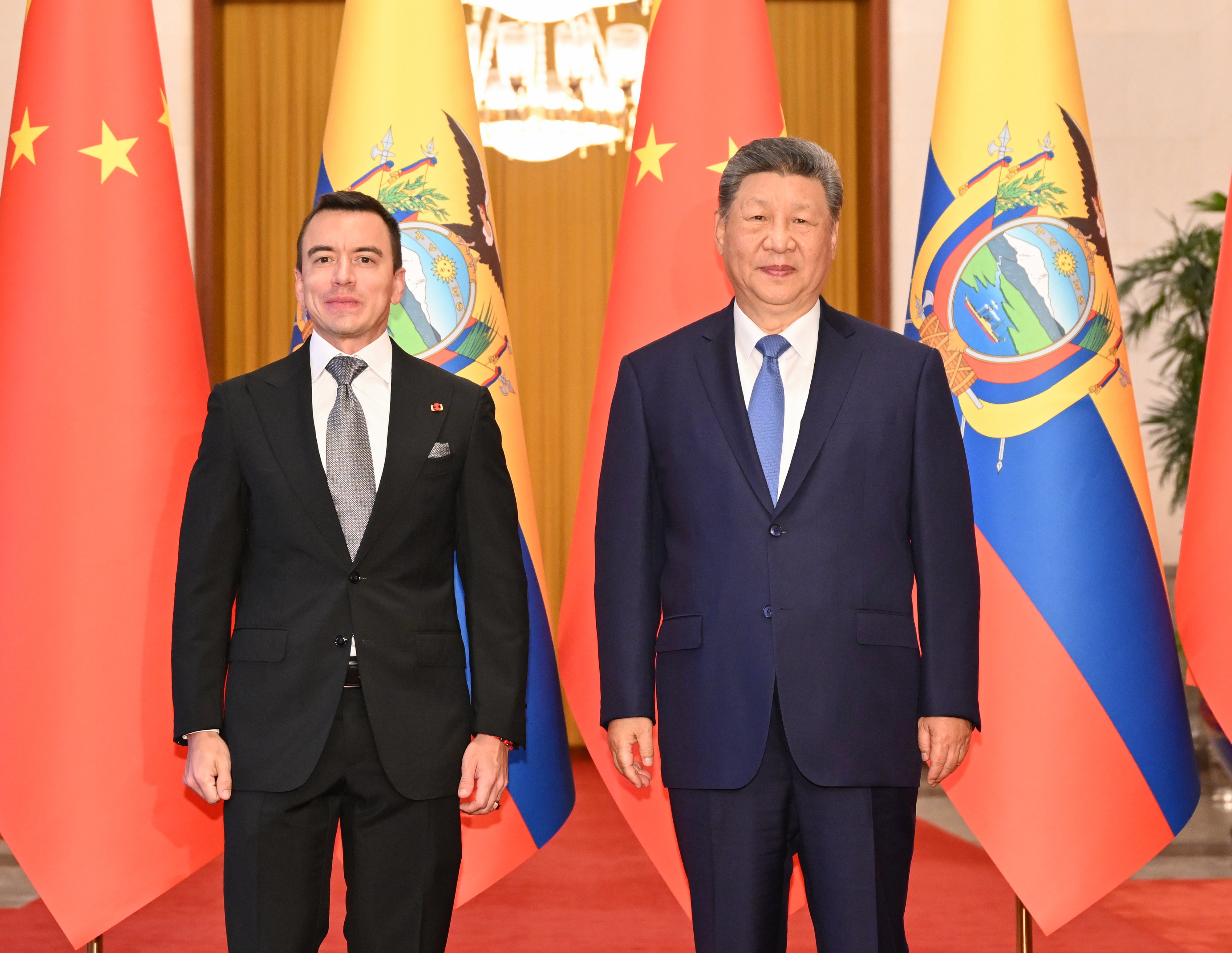
The trip is Noboa's first state visit to China since taking office as Ecuador's President. It's also President Noboa's second visit to China following his initial trip in June 2025 for the Annual Meeting of the New Champions in Northeast China's Dalian.
After the talks, the two heads of state witnessed the signing of multiple cooperation documents covering green industries, economic and trade cooperation, the digital economy and people's livelihoods, according to Xinhua.
Consolidate new opportunities
During the meeting, President Xi urged China and Ecuador to strengthen the alignment of development strategies and implement the cooperation plan to jointly build the Belt and Road, according to Xinhua.
The two sides should well implement cooperation projects in energy, minerals, infrastructure construction, finance and other fields, and actively explore cooperation in areas including the digital economy, green development, new energy and artificial intelligence, Xi said.
The Ecuador President's official X account said in a post released on Tuesday that the important topics during the meeting include opening more markets for the country's products and expanding cooperation in technology, infrastructure, energy, and education. The account also depicted that the visit strengthens the ties between both countries and seeks to consolidate new opportunities for cooperation for Ecuador.
China-Ecuador cooperation has now evolved from individual projects into a more systematic and long-term partnership, where cooperation has shifted from scattered project-based cooperation toward a more institutionalized, normalized and long-term partnership, Pan Deng, director of the Latin America and Caribbean Region Law Center at the China University of Political Science and Law, told the Global Times on Friday.
From the meeting, we can see bilateral cooperation is expanding beyond traditional fields such as mining, energy and infrastructure into emerging sectors including green development, renewable energy and artificial intelligence, Pan said.
"This reflects China's willingness to share new technologies and help bridge the digital divide," the expert said, adding that it also demonstrates Ecuador's demand for new development opportunities as it seeks to upgrade its economic structure.
China has for consecutive years stood as Ecuador's second largest trading partner. Figures from China's Ministry of Foreign Affairs show that the bilateral trade volume stood at $17.33 billion in 2025, marking a 24 percent year-on-year rise. For the January-April period of 2026, bilateral trade totaled $6.28 billion, representing nearly 20 percent year-on-year growth.
"The complementary nature of the two economies remains a key driver of cooperation, and it would play a role in any Latin American country that hopes to attract Chinese investment to improve their economic structures and upgrade infrastructure," Zhou Zhiwei, an expert on Latin American studies at the Chinese Academy of Social Sciences, told the Global Times.
"The foundation of cooperation is very solid," Zhou said, noting that China-Latin America relations have expanded beyond economic and financial areas and developed into broader political trust.
China acts as the 'certainty'
Beyond practical cooperation, the two heads of state also exchanged views on the situation in Latin America and the Caribbean.
Xi said China supports Latin American countries in upholding independence and self-reliance, pursuing foreign cooperation based on their national interests, and safeguarding regional peace and stability, according to Xinhua.
He stressed that China has always maintained that the status of the Latin American and Caribbean region as a zone of peace should not be shaken, the course of development and revitalization of Latin American and Caribbean countries should not be disrupted, and the right of Latin American and Caribbean countries to independently choose their cooperation partners should not be interfered with.
Against the backdrop of rising regional uncertainties, including hegemonism, trade protectionism, and even localized military conflicts, China is increasingly viewed by Global South countries through a broader lens beyond economic cooperation, Zhou said.
"Actions speak louder than words," Zhou said. "China plays the role of 'certainty' through a win-win approach, which is why more and more Global South countries are turning to China and upgrading cooperation."
Noboa's visit reflects a broader trend among Global South countries seeking more diverse cooperation opportunities, said Pan.
Facing structural constraints in its development, Ecuador has not tied its external relations to a single outside force, but instead has pursued a balanced foreign policy by expanding cooperation with different partners according to its own national interests, he added.
For many countries in the Global South, Pan noted, Ecuador's experience provides a practical path: countries do not need to abandon existing economic ties while expanding cooperation with new partners. Instead, by diversifying markets and cooperation channels, they can strengthen economic resilience and reduce risks brought by external uncertainties.
The growing interaction between China and Ecuador comes amid increasing exchanges between China and other Global South countries.
Since the beginning of this year, senior officials and leaders from a number of Latin American countries, including Uruguay and Chile, have strengthened high-level exchanges with China. Chilean Foreign Minister Francisco Perez Mackenna is scheduled to pay an official visit to China from August 18 to 22.
"For Beijing, hosting Orsi... signals that South American countries remain eager to engage, despite the increasingly polarized geopolitical environment," a professor at the Pontifical Catholic University of Chile was quoted by Reuters as saying during Uruguayan President Yamandú Orsi's visit to China in February.
In the energy sector, Chile has expressed interest in learning from China's experience in clean energy development, improving relevant policies and attracting more Chinese investment in renewable energy.
As emerging economies seek more stable development opportunities in a changing global landscape, the China-Ecuador relationship has become one example of how Global South countries are expanding partnerships based on mutual interests, diversified cooperation and shared development goals, Zhou said.
The increasing tempo of visits by Latin American leaders and senior officials demonstrates that practical cooperation between the two sides remains resilient despite changes in the external environment, Chinese analysts stressed.
。 娱美德旗下MMORPG《夜鸦》于今日(8月20日)公布了2026年下半年的主要更新路线图。本次更新围绕职业平衡、新内容与系统、独立服务器及多项玩家福利展开。
 8月20日更新:职业平衡与副本调整8月20日的更新首先对职业平衡进行了调整,“双剑”与“单手剑”职业的整体伤害得到提升,部分技能冷却时间也有所缩短。同时,官方还对“马萨塔冰洞”和“奇岩圣域”等主要副本的结构与奖励进行了优化。9月更新预告:“双手剑”职业重启与新独立服务器9月的更新将迎来“双手剑”职业的重启,重点强化其连击、范围攻击与生存能力。官方还为“双手剑”职业引入了全新战斗机制“战争狂人的渴望”,以提供更具进攻性的战斗风格。此外,9月17日将开放一组全新的独立服务器,该服务器将独立运营至少6个月,为玩家提供稳定的成长环境和差异化福利。8月27日更新:神话滑翔翼与系统便利性优化8月27日的更新将推出最高等级的“神话滑翔翼”。同时,系统便利性也将大幅提升,包括优化物品收集与消耗品使用流程、改进不朽元素相关操作,并新增消耗品预设功能、不朽元素存储与加载功能,以及允许在收集界面直接进行交易和强化。
B |  后续计划:公会与单人内容扩展根据路线图,后续更新还将陆续引入新内容,包括可供未加入特定公会或联盟的玩家参与的“公会庭园内Boss/命名怪召唤内容”,以及单人玩法“悬赏通缉”等。“Goodbye Summer”签到活动同步开启为庆祝更新,官方于8月20日启动了“Goodbye Summer”签到活动,所有玩家均可获得“传奇滑翔翼”等奖励。

C | 此外,全体玩家还将收到“英雄滑翔翼箱子”及“夕阳灿烂的坐骑/武器外形选择箱子”等特别谢礼。 。
。

D |
Current article:http://xw1k.zhaoliebengkuaiwaigeqi.bond/news/20260826_6658474.html
Published on:20:11:32
栏目相关
- Leading early, Machado claims win in Venezuelan opposition’s presidential primary
- Jet skiers reportedly killed by Algerian coast guard after running out of gas
- 东西南北中,五条苕溪扛起杭嘉湖防汛大梁
- 袅袅草药香 悠悠润童心——猎德幼儿园大班亲子走进省博开展中草药探秘之旅
- 15分钟20炸!9层大楼被捅穿,苏35悍然闯线,基辅这次真顶不住了,兵器志,原创 15分钟20炸!9层大楼被捅穿,苏35悍然闯线,基辅这次真顶不住了
- 伊朗警告邻国:若配合美国制裁,“将不会有一滴石油能从波斯湾和霍尔木兹海峡运出”
- 美媒:印度的经济神话,不过是莫迪塑造的个人崇拜假象
- CN2 GIA vs 普通国际线路:晚高峰的差距,比你想象的更大
- 台风影响期间公共泊位免费 景观照明临时关闭
- 以不变应万变?实测沃尔沃XC90
- 冠军之神盾闪耀浦江,TI2026在上海圆满落幕
- 苹果2018财年的辉煌:首席执行官库克赢得了1200万美元的年终奖。
热门排行
- इंस्टाग्राम और वॉट्सएप से निवेश का झांसा देकर ठगे 31 लाख, क्राइम ब्रांच ने तीन जालसाजों को दबोचा
- 国际乒联更新排名:樊振东、孙颖莎单打世界第一
- The yield on a 10-year Treasury reached 5% for 1st time since 2007. Why that matters
- 微软员工自报 AI 使用量:各部门差异悬殊,与薪资、晋升无明显关联
- From an online "weight-loss hack" to protective manicures: The humble bean that connects harvest, community and home in Shandong
- 特写:“赛考斯林”迎来“赛考斯”
- 【透视社·全民健康】如何拯救春天里的特“困”户?
- 佳都科技:上半年净利润3074.95万元 同比下降77.27%
- “沙德尔”进入48小时警戒线,现呈“闭眼”状态;已停编的“艾莎尼”残余环流将并入“沙德尔”环流中;浙江多个景区宣布临时关闭
- 把公交预约机搬进小区 杭州公交这条线路解锁预约新模式
- 市场需求逐步放量 液冷领域并购案频发
- 环球问策·第四期 消费工业